

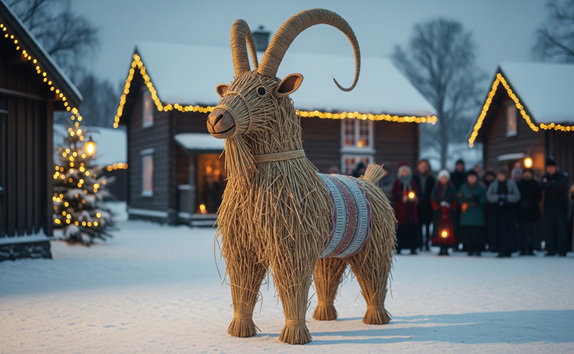
The air grows crisp, the days shorten, and a certain festive magic begins to stir as winter approaches. In the heart of Scandinavian and Northern European traditions, few figures are as charming and enduring as the Yule Goat. More than just a simple decoration, the Yule Goat carries a rich and ancient history, weaving together pagan beliefs, agricultural cycles, and Christian customs into a fascinating tapestry of folklore.
Ancient Roots: Thor and the Harvest Spirit
The origins of the Yule Goat stretch back into the mists of pre-Christian Scandinavia, long before Santa Claus was a twinkle in anyone’s eye. Its earliest connections are often traced to the Norse god Thor, who was said to ride a chariot pulled by two goats, Tanngrisnir and Tanngnjóstr. These goats were not merely beasts of burden; they were powerful symbols of fertility, strength, and protection.
Another significant influence comes from the harvest rituals. In many agricultural societies, the last sheaf of grain harvested was believed to embody the spirit of the harvest itself. This spirit, often associated with fertility and good fortune for the coming year, was sometimes represented by a goat. This “harvest goat” was seen as a protector of the crops and a bringer of prosperity. After the harvest, this last sheaf might be crafted into a goat figure, ensuring the spirit remained present through the winter and returned with the spring planting.
The Medieval Transition: From Pagan to Yuletide
As Christianity spread across Northern Europe, many pagan traditions were not entirely abandoned but rather adapted and integrated into the new religious framework. The Yule Goat was no exception. The midwinter festival of Yule, with its focus on light returning and the turning of the year, gradually merged with Christmas celebrations.
During this period, the Yule Goat began to take on different roles. In some areas, particularly Sweden, the goat transformed into a benevolent bringer of gifts, a precursor to Santa Claus. Known as the “Julbock,” it would often be represented by a person dressed as a goat, going from house to house, singing songs, and sometimes even distributing small presents. This gift-giving aspect was particularly prominent in the 17th and 18th centuries.
However, the Yule Goat also retained a more mischievous, even slightly intimidating, side. In some traditions, it was a creature that demanded offerings, ensuring good luck for the household if appeased, or causing trouble if ignored. The straw goat figures, crafted from the leftover harvest straw, became common household decorations, symbolizing the continuation of the harvest spirit and a wish for a bountiful new year.
Modern Manifestations: A Beloved Symbol
By the 19th and 20th centuries, the gift-giving role of the Yule Goat largely faded as the figure of the Jultomten (Christmas gnome/Santa Claus) became more dominant. Yet, the Yule Goat did not disappear. Instead, it evolved into a beloved decorative symbol, particularly in Sweden.
Today, the most iconic representation of the Yule Goat is the large straw goat, often adorned with red ribbons, that graces town squares and homes throughout Scandinavia during the Christmas season. The most famous of these is undoubtedly the Gävle Goat in Sweden, an enormous straw goat erected annually since 1966. While a beautiful symbol of tradition, the Gävle Goat has also become famous for its unfortunate tendency to be burned down by vandals, adding a quirky, rebellious chapter to its long history.
From its ancient roots as a symbol of Thor’s power and the harvest spirit, through its medieval transformation into a gift-giver and a demanding presence, to its modern role as a cherished Christmas decoration, the Yule Goat stands as a testament to the enduring power of tradition and the fascinating ways in which cultures adapt and preserve their heritage. It reminds us that even in our modern world, the echoes of ancient beliefs can still bring warmth and wonder to the darkest days of winter.
Comment here